Friday, April 15, 2011

Proposal

Everyday when you wake up, the first thing you think about is on eating or on how your day is going to be like. Your mornings might be nice and somedays they might be bad, but on Iraq its not like that, on Iraq they are always frightened and they constantly think if they will make it alive while they sleep. People on Iraq wake up everyday praying to god that they could get through the day alive and on the night praying so they could sleep and wake up on the next morning. They are afraid of being killed even when they are in their houses. Here, where we live at people feel safe while they are at their house. In Iraq people are scared to be outside and inside of their houses. They are afraid that while they are doing something in or outside of their house someone could come and kill them

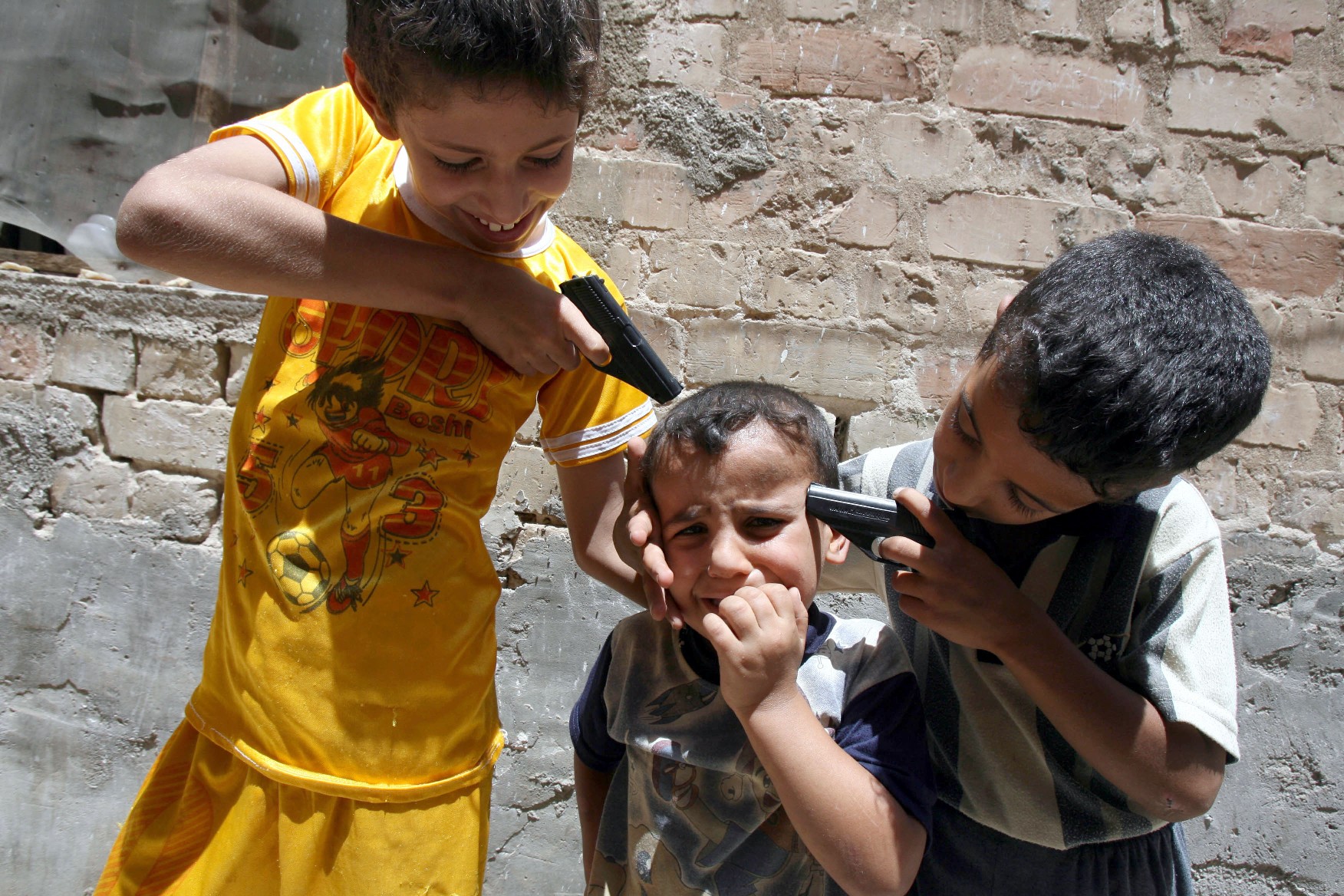
War is constantly happening in Iraq, for every small thing they argue, fight, and even try to kill each other. We want the best for our kids and having war constantly doesn't help. Adults should be the biggest example and in Iraq they are just showing kids how to fight and kill each other. Fighting shouldn't be something that they teach their kids to do for every problem they have or just because someone else didn't agree with them. Kids are our future and they should be teached to treat people nicely and not create or cause problems that may proceed to causing war.


I think that Iraq needs a push up so they could realize the bad they are doing.

Wednesday, April 13, 2011

Traumatizing News from Iraq

1 November 2010
Dozens of people had been killed as security forces stormed a Catholic church in Baghdad to free dozens of hostage, according to a the Deputy Interior official. Maj Gen Hussein Kamal suggested six attackers had also died in the fighting, though other sources have said the overall death toll was lower. About 100 people had been inside Our Lady of Salvation for an evening Mass. The gunmen had reportedly demanded the release of jailed al-Qaeda militants.

News

Mutlag holds meetings with UNAMI, Lebanon, Croatian ambassadors, separately


12/04/2011
Baghdad-Deputy Prime Minister, Salih Al Mutlag, held three separate meetings with UNAMI delegation headed by Jersey Scoranoves, Lebanon ambassador, and Croatian ambassador to Iraq. A statement issued by Mutlag’s office mentioned that the Deputy “stressed, during his meeting with UNAMI, the necessity of UN bearing its responsibilities toward the Iraqi people and double its efforts especially when US troops complete withdrawing from Iraq.”The statement added that Mutlag discussed with Lebanese ambassador Hazza Sharif “the brethren relations between Iraq and Lebanon and the preparations for the Arab Summit.”The statement went on saying that Mutlag tackled the importance of activating mutual economic and services relations and inaugurating investment cooperation during his meeting with Croatian ambassador.

AED (Adhesive Explosive Device) goes off in western Baghdad

A civilian was killed and two others injured when an Adhesive Explosive Device attached to a civilian vehicle exploded in western Baghdad on Tuesday.Police source stated  “The AED exploded at 14 Ramadan St. and also resulted in burning the vehicle.”

National Iraqi News Agency
Iraq/ Yahoo News

It's Increidible Background History!! ♥

Government Type of Government:
Parliamentary democracy- is a system of representative government in which the dominant party in the legislature determines the Prime Minister.

Independence:

 On October 3, 1932, Iraq gained independence from British administration under a League of Nations Mandate. Several acts after 1958 resulted in dictatorship, with the Ba’ath Party seizing power in 1963 and again in 1968. From July 1979 to March 2003, Iraq was ruled by Saddam Hussein and the Ba’ath Party.  On June 28, 2004, the CPA (Coalition Provisional Authority) transferred sovereignty(independent authority over a geographic area, such as a territory) to the Iraqi government. On June 31, 2009, U.S. troops withdrew from urban areas, a step that reinforced Iraqi sovereignty. On March 7, 2010, Iraq held a second round of national elections to choose the members of the Council of Representatives and, in turn, the executive branch of government.
Branches:

  • Executive- Presidency Council (one president and two vice presidents; this configuration may change following the March 2010 national elections and the formation of a new government; Council of Ministers (one prime minister, two deputy prime ministers, and 37 cabinet ministers).
  • Judicial- Supreme Court appointed by the prime minister and confirmed by the Council of Representatives.
  • Legislative- Council of Representatives (COR) consisting of 325 members.
Constitution:
 October 15, 2005.

Leaders:
Heads of State 
 
  • King- Faysal II ibn Ghazi al-Hashimi  4 Apr 1939 - 14 Jul 1958   


Presidents of the state
  • Ghazi Mashal `Ajil al-Yawar    28 Jun 2004 -  7 Apr 2005
  • Jalal at-Talabani               7 Apr 2005 


Heads of the Government
Prime Ministers:
  • Hamdi al-Bajaji 4 Jun 1944 - 23 Feb 1946
  • Sulayman Tawfiq Bey as-Suwaydi 23 Feb 1946 - 1 Jun 1946
  • Arshad al-Umari 1 Jun 1946 - 21 Nov 1946
  • Nuri Pasha as-Said 21 Nov 1946 - 29 Mar 1947 (+1958)e 


  • Salih Jabr 29 Mar 1947 - 29 Jan 1948
  • Muhammad as-Sadr 29 Jan 1948 - 26 Jun 1948
  • Muzahim al-Bajaji 26 Jun 1948 - 6 Jan 1949
  • Nuri Pasha as-Said 6 Jan 1949 - 10 Dec 1949
  • Ali Jawdat al-Aiyubi 10 Dec 1949 - 5 Feb 1950
  • Sulayman Tawfiq Bey as-Suwaydi 5 Feb 1950 - 15 Sep 1950
  •  Nuri Pasha as-Said 15 Sep 1950 - 12 Jul 1952
  • Mustafa Mahmud al-Umari 12 Jul 1952 - 23 Nov 1952
  • Nureddin Mahmud 23 Nov 1952 - 29 Jan 1953 military
  • Jamil Bey al-Midfai 29 Jan 1953 - 17 Sep 1953 (+1959)
  •  Muhammad Fadhel al-Jamali 17 Sep 1953 - 29 Apr 1954 Arshad al-Umari 29 Apr 1954 - 4 Aug 1954
  • Nuri Pasha as-Said 4 Aug 1954 - 20 Jun 1957 (+1958)e
  • Ali Jawdat al-Aiyubi 20 Jun 1957 - 15 Dec 1957
  • `Abd al-Wahhab Marjan 15 Dec 1957 - 3 Mar 1958 (+1964)
  • Nuri Pasha as-Said 3 Mar 1958 - 18 May 1958 (+1958)e
  • Ahmad Mukhtar Baban 18 May 1958 - 14 Jul 1958 (+)e
  • `Abd al-Karim Kassem 14 Jul 1958 - 8 Feb 1963 (+)e  military
  •  Ahmad Hassan al-Bakr 8 Feb 1963 - 18 Nov 1963 (+1982)military/Baath
  • Tahir Yahya 20 Nov 1963 - 6 Sep 1965 (+1986) military/ASU
  • `Aref `Abd ar-Razzaq 6 Sep 1965 - 21 Nov 1965 military/ASU
  • `Abd ar-Rahman al-Bazzaz 21 Nov 1965 - 9 Aug 1966 (+1973)e
  • Naji Talib 9 Aug 1966 - 10 May 1967
  • `Abd ar-Rahman Muhammad `Aref 10 May 1967 - 10 Jul 1967 (+2007) military/ASU
  • Tahir Yahya 10 Jul 1967 - 17 Jul 1968 (+1986) military/ASU
  • `Abd ar-Razzaq Said an-Najif 17 Jul 1968 - 30 Jul 1968 (+1978)a military
  • Ahmad Hassan al-Bakr 31 Jul 1968 - 16 Jul 1979 (+1982)  military/Baath
  • Saddam Hussein at-Tikriti 16 Jul 1979 - 23 Mar 1991 (+2006)e  Baath
  • Saadun Hammadi 23 Mar 1991 - 13 Sep 1991 (+2007)  Baath
  • Muhammad Hamzah az-Zubaydi 16 Sep 1991 - 5 Sep 1993 (+2005)  Baath
  • Ahmad Hussein as-Samarraj 5 Sep 1993 - 29 May 1994
  • Baath Saddam Hussein at-Tikriti 29 May 1994 - 9 Apr 2003 (+2006)e Baath

 It's Amazing History
Muslims conquered Iraq in the seventh century A.D. In the eighth century, the Abassid caliphate established its capital at Baghdad. The territory of modern Iraq came under the rule of the Ottoman Turks early in the 1500s. At the end of World War I, Ottoman control ended and Iraq came under the authority of a British mandate. When it was declared independent in 1932, the Hashemite family, a branch of which also ruled Jordan, ruled as a constitutional monarchy. In 1945, Iraq joined the United Nations and became a founding member of the Arab League. In 1956, the Baghdad Pact allied Iraq, Turkey, Iran, Pakistan, and the United Kingdom, and established its headquarters in Baghdad.Gen. Abdul Karim Qasim took power in a July 1958 coup, during which King Faysal II and Prime Minister Nuri as-Said were killed. Qasim ended Iraq's membership in the Baghdad Pact in 1959. Qasim was assassinated in February 1963, when the Arab Socialist Renaissance Party (Ba'ath Party) took power under the leadership of Gen. Ahmad Hasan al-Bakr as prime minister and Col. Abdul Salam Arif as president.Nine months later, Arif led a coup ousting the Ba'ath government. In April 1966, Arif was killed in a plane crash and was succeeded by his brother, Gen. Abdul Rahman Mohammad Arif. On July 17, 1968, a group of Ba'athists and military elements overthrew the Arif regime. Ahmad Hasan al-Bakr reemerged as the President of Iraq and Chairman of the Revolutionary Command Council (RCC).In July 1979, Bakr resigned, and his cousin Saddam Hussein, already a key figure in the Ba’ath party and the RCC, assumed the two offices of President and RCC Chairman. The Iran-Iraq war (1980-88) devastated the economy of Iraq. Iraq declared victory in 1988 but actually achieved a weary return to the status quo antebellum. The war left Iraq with the largest military establishment in the Gulf region but with huge debts and an ongoing rebellion by Kurdish elements in the northern mountains. The government suppressed the rebellion by using chemical and biological weapons on civilian targets, including a mass chemical weapons attack on the Kurdish city of Halabja that killed several thousand civilians.

Iraq invaded Kuwait in August 1990, but a U.S.-led coalition acting under United Nations (UN) resolutions expelled Iraq in February 1991. After the war, Kurds in the north and Shi'a Muslims in the south rebelled against the government of Saddam Hussein. The government responded quickly and with crushing force, killing thousands, and pursued damaging environmental and agricultural policies meant to drain the marshes of the south.
As a result, the United States, United Kingdom, and France established protective no-fly zones in northern and southern Iraq. Coalition forces enforced no-fly zones in southern and northern Iraq to protect Iraqi citizens from attack by the regime and a no-drive zone in southern Iraq to prevent the regime from massing forces to threaten or again invade Kuwait. In addition, the UN Security Council required the regime to surrender its weapons of mass destruction (WMD) and submit to UN inspections. A U.S.-led coalition invaded Iraq in March-April 2003 and removed the Ba'ath regime, leading to the overthrow of the dictator Saddam Hussein. (Following his capture in December 2003 and subsequent trial, Saddam Hussein was executed on December 30, 2006 by the Government of Iraq.) The Coalition Provisional Authority (CPA) assumed security and administrative responsibility for Iraq while Iraqi political leaders and the Iraqi people established a transitional administration. The CPA’s mission was to restore conditions of security and stability and to create conditions in which the Iraqi people could freely determine their own political future. The UN Security Council acknowledged the authority of the Coalition Provisional Authority and provided a role for the UN and other parties to assist in fulfilling these objectives.

The CPA disbanded on June 28, 2004, transferring sovereign authority for governing Iraq to the Iraqi Interim Government (IIG). Based on the timetable laid out in the Transitional Administrative Law (TAL), the IIG governed Iraq until elections were held on January 30, 2005; thereafter, the Iraqi Transitional Government assumed authority.

In May 2005, the Iraqi Transitional Government appointed a multi-ethnic committee to draft a new Iraqi constitution. The new constitution was finalized in September 2005, and was ratified in a nationwide referendum on October 15, 2005. On December 15, 2005, Iraqis again went to the polls to participate in the first national legislative elections as established by the new constitution. The new 4-year, constitutionally based government took office in March 2006, and the new cabinet was approved and installed in May 2006. By that time, following the February 2006 bombing of the Golden Mosque in Samara, violence in the country was widespread.The ongoing violence and instability prompted President George W. Bush to increase troop numbers in Iraq (the “surge” in U.S. forces) in an attempt to improve the security situation and give Iraqi political leaders an opportunity to address the many problems that plagued the Iraqi people. Following the troop increase and adjustments to military strategy, violence declined, thereby providing political space and an improved environment for leaders to make progress on difficult national issues. In January 2009 two bilateral agreements between the United States and the Government of Iraq took effect: 1) the “Agreement between the United States of America and the Republic of Iraq On the Withdrawal of United States Forces from Iraq and the Organization of Their Activities During Their Temporary Presence in Iraq” (referred to as the “Security Agreement”) governs the presence and status of U.S. forces in Iraq, and addresses the withdrawal of these forces; and, 2) the “Strategic Framework Agreement for a Relationship of Friendship and Cooperation between the United States of America and the Republic of Iraq” (referred to as the“Strategic Framework Agreement” or “SFA”) sets out a variety of areas and aims for bilateral cooperation and forms the basis for a long-term partnership with the people and Government of Iraq.

On January 31, 2009, Iraq held elections for provincial councils in all provinces except the three provinces comprising the Kurdistan Regional Government and at-Ta’mim (Kirkuk) province. On March 7, 2010, Iraq held national elections in which parties competed for positions in the Council of Representatives and the executive branch. In June 2009, in accordance with the bilateral Security Agreement, U.S. forces withdrew from urban areas in Iraq. On August 31, 2010, President Barack Obama announced the end of major combat operations, the completion of the withdrawal of all U.S. combat brigades, and the transition of the role of the remaining U.S. military force of 50,000 troops to advising and assisting Iraqi security forces. By December 31, 2011, all U.S. military forces will withdraw from the country.

Thursday, April 7, 2011

Iraq's Increidible History

Iraq lies in what historians and geographers commonly refer to as the Fertile Crescent.The Fertile Crescent is a name for a relatively fertile arc-shaped area. Running through the heart of the country are two great rivers (Tigris and Euphrates) that at one time fed and nourished the beginnings of civilization. Because these two rivers flood periodically, leaving behind fertile soil after the waters recede, farmers were able to produce crops in abundance.
Once known as Mesopotamia, Iraq was the site of flourishing ancient civilizations, including the Sumerian, Babylonian, and Parthian cultures. Muslims conquered Iraq in the seventh century A.D. In the eighth century, the Abassid caliphate established its capital at Baghdad. The territory of modern Iraq came under the rule of the Ottoman Turks early in the 1500s.

Food
 Prior to the United Nations economic sanctions, the traditional diet included rice with soup or sauce, accompanied by lamb and vegetables. Today, because food is tightly rationed, most people eat rice or another grain sometimes with sauce. Both vegetables and meat are hard to come by. In rural areas it is customary for families to eat together out of a common bowl, while in urban areas individuals eat with plates and utensils.

Food Customs at Ceremonial Occasions
It is traditional to sacrifice a lamb or a goat to celebrate holidays. However, today few Iraqis have the means to do this, and celebrations are now minimal.

Economy
 Iraq's economy is currently in a difficult position. Following the 1991 Persian Gulf War, the United Nations imposed Security Council Resolution 687, which requires Iraq to disclose the full extent of its programs to develop chemical and nuclear weapons and missiles, and to eliminate its weapons of mass destruction. Until Iraq complies with these requirements, the United Nations attests that there will be an economic embargo and trade sanctions against Iraq. At first the resolution meant that Iraq could not assume trade relations with any foreign country.

Trade
 Iraq may only legally trade with other countries through the oil-for-food program, wherein they are allowed to sell oil to buy basic food supplies. However, diplomatic reports have indicated that Iraq has been illegally exporting some of its medical supplies and food, purchased through the oil-for-food program, to Lebanon, Syria, and Jordan. Prior to the sanctions, Iraq's main exports were crude oil, refined petroleum products, natural gas, chemical fertilizers, and dates. Its major trade partners were Russia, France, Brazil, Spain, and Japan.

Social Classes

Classes and Castes
 Arabs, Kurds, and other ethnic groups each have their own social stratospheres, and no one ethnicity dominates another in a caste system. In terms of social class there is great disparity between rich and poor. Those who compose the high class in society of Iraq are essentially chosen by the government, since there is no opportunity to start a business or make a name for oneself without the endorsement of the government. The once-dominant middle class of the 1970s has deteriorated in the face of the economic crisis. These people, who are very well educated, now perform unskilled labor, if they have jobs at all, and have joined the ranking of the majority lower or poor class.


Culture of Iraq 
Iraq

Tuesday, April 5, 2011

Iraq's Overview


 Country Name
  • conventional long form: Republic of Iraq
  • conventional short form: Iraq
  • local long form: Jumhuriyat al-Iraq
  • local short form: Al Iraq


Location
Iraq is in the Middle East, is 168,754 square miles (437,073 square kilometers), which is equal to twice the size of Idaho. Iraq is bordered by Iran, Saudi Arabia, Turkey, Syria, and the Persian Gulf. It's geographic coordinates are 33.00 N 44.00 E.
total: 438,317 sq km
country comparison to the world: 58
land: 437,367 sq km
water: 950 sq km

Population
The estimated Iraqi population for 2000 is 22,675,617 people.

 
Population Below Poverty Line
  • 25% (2008 est.)
 
Population Growth Rate
  • 2.399% (2011 est.)
  • country comparison to the world: 31

Age Structure
0-14 years: 38% (male 5,882,682/female 5,678,741)
15-64 years: 58.9% (male 9,076,558/female 8,826,545)
65 years and over: 3.1% (male 435,908/female 499,138) (2011 est.)

Birth Rate
  • 28.81 births/1,000 population (2011 est.)
  • country comparison to the world: 45
Death Rate
 
  • 4.82 deaths/1,000 population (July 2011 est.)
  • country comparison to the world: 194
Major Cities Population


  • Baghdad (capital) 5.751 million
  • Mosul 1.447 million
  • Erbil 1.009 million
  • Basra 923,000
  • As Sulaymaniyah 836,000 (2009)
HIV/AIDS - Adult Prevalence Rate
  • less than 0.1% (2001 est.)
  • country comparison to the world: 157


HIV/AIDS - People living with HIV/AIDS 
  • fewer than 500 (2003 est.)
  • country comparison to the world: 154
Language
Almost all Iraquis speak Arabic. Almost all of the Iraquis speak and understand their official language very well.Arabic,was introduced by the Arab conquerors and has 3 different forms: classical, modern standard, and spoken.The Classical arabic is the written language of the Qur'an. The Modern Standard Arabic is taught in schools for kids to read and write.
Other languages used are:
  • Kurdish (official in Kurdish regions)
  • Turkoman (a Turkish dialect)
  • Assyrian (Neo-Aramaic)
  • Armenian

Ethnic Groups
  • Arab 75%-80%, Kurdish 15%-20%, Turkoman, Assyrian, or other 5%
Religions
  • Muslim 97% (Shia 60%-65%, Sunni 32%-37%), Christian or other 3%

Government Type
  • parliamentary democracy
Legal System
based on European civil and Islamic law under the framework outlined in the Iraqi Constitution; has not accepted compulsory ICJ jurisdiction


Suffrage/Voting Rights
  • 18 years of age; universal


Climate
Iraq is mostly desert.It has mild cool winters but dry, hot and, cloudless summers.The northern mountainous regions along Iranian and Turkish borders have cold winters with some heavy snows that melt in early spring, sometimes causing extensive flooding in central and southern Iraq.

Natural Resources
Iraq has some important natural resources, which are:
  • petroleum
  • natural gas
  • phosphates
  • sulfur
It's Natural Dangers
Iraq's natural dangers are:
  • dust storms
  • sandstorms
  • floods
Enviornment
Iraq's government water control projects have drained most of the inhabited marsh areas (of soft, wet, low-lying land, characterized by grassy vegetation) east of An Nasiriyah by drying up or diverting the feeder streams and rivers. Once sizeable population of Marsh Arabs, who lived on these areas for thousands of years, has been displaced away from their homes. Leaving the destruction of the natural habitat that endangers the area's wildlife populations.
Industries
  • petroleum
  • chemicals
  • textiles
  • leather
  • construction materials
  • food processing
  • fertilizer
  • metal fabrication/processing


Communications

Telephones- Main Lines in use
  • 1.108 million (2009)
  • country comparison to the world: 73
Telephones- Mobile Cellular
  • 19.722 million (2009)
  • country comparison to the world: 40
Tansportations

 Airports
  • 104 (2010)
Heliports
  • 21 (2010)

Railways
  • total: 2,272 km
  • country comparison to the world: 69
  • standard gauge: 2,272 km 1.435-m gauge (2008)

Roadways
  • total: 44,900 km
  • country comparison to the world: 82
  • paved: 37,851 km
  • unpaved: 7,049 km (2002)
 Waterways
  • 5,279 km
  • country comparison to the world: 23
Euphrates River (2,815 km), Tigris River (1,899 km), and Third River (565 km) are principal waterways (2010)

Military

Military Service Age and Obligation
  • 18-40 years of age for voluntary military service (2010)
Refugees and Internally Displaced Persons
  • refugees (country of origin): 10,000-15,000 (Palestinian Territories); 11,773 (Iran); 16,832 (Turkey)
  • IDPs: 2.4 million (ongoing US-led war and ethno-sectarian violence) (2007)


EveryCulture
Iraq
Flag
Three equal horizontal bands of red (top), white, and black; the Takbir (Arabic expression meaning "God is great") in green Arabic script is centered in the white band; the band colors derive from the Arab Liberation flag and represent oppression (black), overcome through bloody struggle (red), to be replaced by a bright future (white); the Council of Representatives approved this flag in 2008 as a compromise temporary replacement for the Ba'athist Saddam-era flag.
National Anthem
    • name: "Mawtini" (My Homeland)
    •  adopted on 2004.It follows the ousting of Saddam Hussein, Iraq adopted "Mawtini," a popular folk song throughout the Arab world, which also serves as an unofficial anthem of the Palestinian people.